
The traditional search engine results page has undergone its most radical transformation in decades. You’ve likely seen your click-through rates soften whilst AI-powered summaries take up more space at the top of the screen. It’s a common concern amongst business owners across Ireland who fear their hard-earned visibility is being erased by automated responses. Learning what is answer engine optimization is the essential next step to ensure your brand is the one being synthesised and recommended by these new digital gatekeepers.
Discover how Answer Engine Optimization (AEO) ensures your brand is the first choice for AI assistants and conversational search engines. This 2026 guide provides a clear understanding of AEO mechanics and actionable steps to update your current website content for maximum visibility. We’ll examine how to earn the trust of Large Language Models through technical precision and authoritative answers, ensuring your business remains at the centre of the user’s journey.
Key Takeaways
- Understand the shift from traditional Google “blue links” to conversational interfaces like Perplexity and how this affects your brand visibility in the Irish market.
- Learn exactly what is answer engine optimization and how to structure your content so Large Language Models can easily synthesise and cite your business.
- Discover why AEO doesn’t replace SEO but acts as a critical layer to drive your brand directly into user conversations whilst SEO handles site traffic.
- Master the “Inverted Pyramid” content model and advanced Schema Markup to communicate your expertise directly to AI crawlers without technical friction.
- Identify why bespoke web design is essential for AEO success, as custom-built sites eliminate the code bloat that often confuses AI models.
The Evolution of Search: From Blue Links to Direct Answers
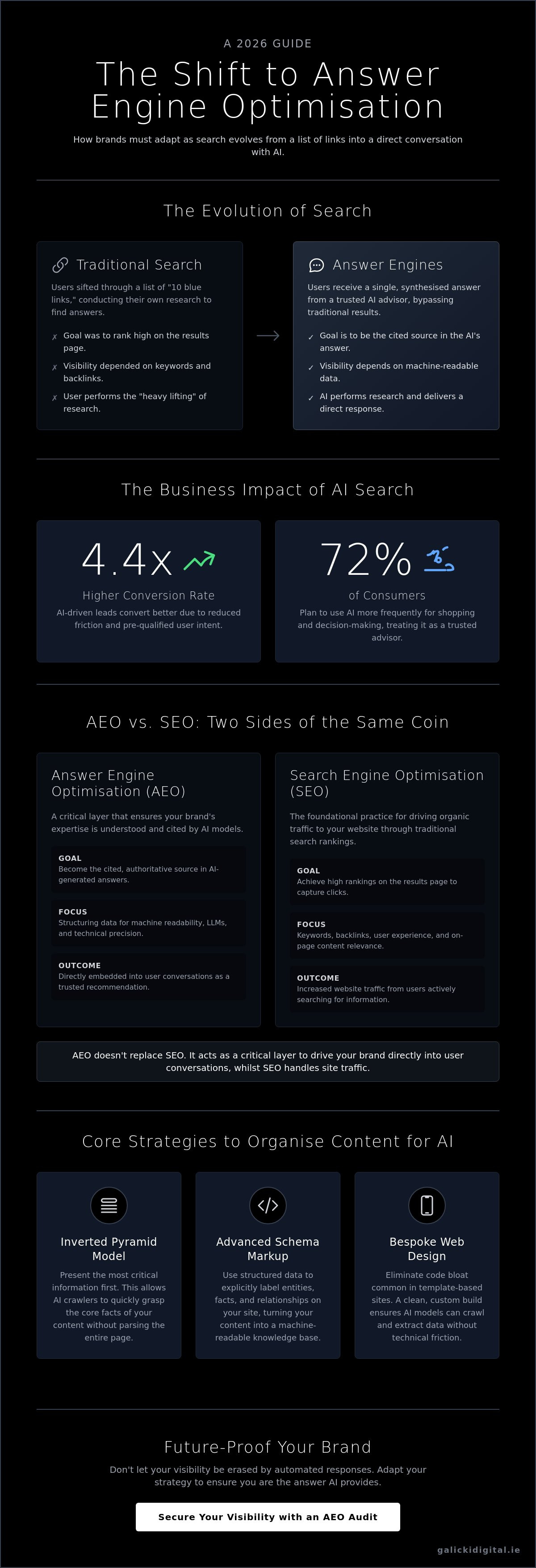
For decades, the digital journey began with a list of ten blue links. By May 2026, this behaviour has largely vanished. Data reveals that users are increasingly bypassing the scroll in favour of immediate, synthesised answers. To understand this shift, we must look at The Evolution of Search from a simple index of pages to a sophisticated network of cited facts. This transition means that simply ranking is no longer enough. Understanding what is answer engine optimization is now the only way to ensure your brand isn’t bypassed by the very technology your customers use to find you.
The psychological shift is profound. Users no longer view search engines as libraries; they treat them as trusted advisors. Instead of doing the heavy lifting of research themselves, 72% of consumers now plan to use AI for shopping and decision-making more frequently. They expect a single, accurate response that accounts for their specific context. If your business isn’t the one being cited by these models, you effectively don’t exist in the eyes of the modern consumer.
The Rise of Generative Search Experiences (SGE)
Google has fundamentally altered its interface by placing AI-generated summaries at the top of almost every informational query. These summaries synthesise data from across the web to answer questions instantly. This has decimated organic click-through rates for traditional SEO. In this environment, “being the answer” is significantly more valuable than holding the number one organic spot. Brands that fail to adapt their content structure find themselves buried beneath a wall of AI-generated text. Integrating what is answer engine optimization into your digital strategy is the only way to reclaim that visibility and earn a citation within the AI’s response.
Why AI Search Converts Better in 2026
Industry data suggests that AI-driven leads now convert at a rate 4.4x higher than traditional search traffic. This isn’t a fluke; it’s a result of reduced friction. When a user asks a conversational engine for a recommendation, the AI filters out irrelevant options based on the user’s past behaviour and specific intent. It provides a personalised answer that matches their exact situation, such as finding a bespoke web design agency in Dublin that specialises in high-performance retail sites. By the time the user clicks a link provided by the AI, they’ve already been “pre-sold” by the advisor they trust. This removes the “choice paralysis” often found on traditional SERPs, leading to faster decisions and higher quality enquiries for your business.
Defining Answer Engine Optimization (AEO) and How it Works
To move beyond the traditional search index, you must view your website as a data source for Large Language Models (LLMs). Whilst traditional search bots crawl pages to create a library of links, AI engines synthesise your content to extract facts, entities, and relationships. They don’t just want to find your page; they want to understand the information well enough to repeat it to a user with absolute authority. When defining what is answer engine optimization, it is helpful to think of it as the process of structuring and tailoring your digital content so it can be effortlessly understood by machines. AEO is the strategic bridge between your brand’s data and an AI’s response.
To succeed in this environment, your content must become a primary part of the “Corpus”, the massive data set these models rely on for knowledge. If an AI model hasn’t encountered your brand’s expertise during its training or via real-time retrieval, you effectively don’t exist in its knowledge base. If you are still asking what is answer engine optimization in a practical sense, it is the act of making every piece of information on your site machine-readable. It is no longer enough to have a visually appealing site; you need a data structure that allows an AI to verify your claims instantly. If you are unsure where to start, a professional SEO audit can identify the technical gaps preventing AI models from reading your site correctly.
The Role of Large Language Models (LLMs)
In 2026, the landscape is dominated by three main players: OpenAI’s ChatGPT, Anthropic’s Claude, and Google’s Gemini. These models use a process called Retrieval-Augmented Generation (RAG) to pull live data from the web and combine it with their pre-trained knowledge. This makes your website’s technical performance more critical than ever. If your site is slow or cluttered with code bloat, the AI’s retrieval window might close before it can extract your data. High-speed, responsive web development ensures that these models can access your content in the milliseconds they have to formulate an answer. You can find more details on Core Strategies to Organise Your Content to ensure your site meets these rigorous technical standards.
The Feedback Loop: Citations and Recommendations
AI engines don’t pick sources at random. They prioritise accuracy and authority, often referred to as the “Trust Factor”. When an engine like Perplexity or ChatGPT Search provides an answer, it includes footnotes to cite its sources. To be included, your brand must have a consistent presence across the wider web, including structured data and mentions in reputable Irish publications. Statistics show that 87.4% of all AI referral traffic across ten key industries currently comes from ChatGPT alone. Securing a citation in that specific feedback loop requires your brand to be seen as the definitive source for your niche, preventing your business from being ignored in favour of more legible competitors.
AEO vs SEO: Why You Need Both for Digital Visibility
Search Engine Optimisation (SEO) and Answer Engine Optimisation (AEO) are often viewed as rivals, but they are actually two sides of the same coin. Traditional SEO is built to improve your ranking for specific keywords to drive clicks to your website. Conversely, AEO focuses on providing immediate, accurate responses to user intent directly within the search interface. Whilst SEO ensures your business appears in the index, AEO ensures your brand is the one providing the answer in a conversational interface. Understanding what is answer engine optimization requires seeing it as an evolution rather than a replacement. You still need the traffic that SEO provides, but you also need the authority that AEO grants within AI summaries.
The synergy between the two is vital. High-quality SEO content acts as the proof that AI models require to verify their answers. If your site has a strong backlink profile and clear topical authority through long-form content, an AI engine is more likely to trust your data. By May 2026, 90.3% of marketing organisations have integrated AI into their strategy, proving that Future-Proofing Your Brand involves a dual-track approach. You are building a library for humans and a database for machines simultaneously. If your current site feels outdated, a professional website redesign process checklist can help align your technical foundation with these dual requirements.
Key Differences in Content Strategy
Traditional SEO strategies usually revolve around keyword density and long-form blogs designed to keep users on the page. In contrast, AEO prioritises directness. It utilises Q&A formatting and the “inverted pyramid” model where the answer comes first, followed by supporting evidence. This doesn’t mean you should delete your blogs. Instead, you should organise your content so that an AI can easily extract a 50-word summary for a voice assistant whilst a human reader can still dive into the full article. This balance ensures you don’t lose the 31% of users who still prefer clicking through to a full website.
The Technical Overlap
Both disciplines share a foundation in technical excellence. Core Web Vitals remain a critical metric because a fast-loading site is easier for both Google’s bots and an AI’s retrieval-augmented generation (RAG) system to process. A bespoke web design is particularly advantageous here, as it avoids the code bloat found in many off-the-shelf templates that can confuse AI crawlers. Clean, semantic HTML and a mobile-first architecture ensure that digital agents can navigate your site without friction. When your website is built with a clear structure and precise schema markup, you provide a roadmap that makes it effortless for an AI to identify your brand as the definitive source for a query.
Core Strategies to Organise Your Content for AI Answer Engines
To capture the attention of modern AI models, your content must be structured using the “Inverted Pyramid”. This journalistic model prioritises the most critical information at the very top of the page. When defining what is answer engine optimization in a practical context, it involves providing a direct answer in the first 50 words of a section, followed by supporting data and deeper analysis. This ensures that an AI agent, which has limited time to “read” and synthesise your page, finds the relevant facts immediately. 2026 AEO success relies on being the most helpful, concise source available.
Many Irish businesses struggle because their websites are built on bloated templates that bury information under layers of unnecessary code. AI engines prefer clean, semantic structures where the relationship between a question and its answer is unmistakable. If your site is currently cluttered, investing in bespoke AEO services can help restructure your digital home into a high-performance data source that AI models trust and cite.
Conversational Content Frameworks
You should adopt a “Question-Answer-Evidence” model for every H2 section on your website. Start with a clear question that reflects how people actually speak to voice assistants or type into ChatGPT. Follow this with a concise answer, then provide the evidence or expertise that proves your claim. Avoid the corporate jargon that often confuses Large Language Models. Instead, use natural, authoritative language that demonstrates clear intent. This approach makes it easier for an AI to extract your content for “zero-click” answers whilst still providing value to the human readers who click through.
The Power of Structured Data (Schema.org)
In 2026, advanced Schema Markup is the primary way you “talk” to an AI. “Speakable” and “FAQ” schema are now non-negotiable for any brand wanting to appear in conversational search results. Bespoke WordPress development allows for much cleaner and more precise metadata than standard plugins, which often add “code bloat” that obscures your data. By using linked data, you can connect your brand to established entities in the Knowledge Graph. This technical precision ensures that when an AI looks for a “bespoke web designer in Ireland”, your site provides the machine-readable proof required to be the top recommendation.
Authority and E-E-A-T in the AI Era
Expertise is the only thing an AI cannot fake. Whilst an LLM can synthesise information, it cannot replicate the real-world experience of a legitimate national authority. Building a digital footprint through external citations, guest appearances on reputable Irish podcasts, and high-quality PR “teaches” the AI who you are. These external signals act as a verification layer for the information on your site. When multiple trusted sources point to your business as an expert in responsive web development, AI engines gain the confidence to recommend your services over a competitor with a weaker digital reputation.
Future-Proofing Your Brand with Bespoke AEO Services
Many business owners in Ireland are discovering that their existing websites, often built on generic templates, are practically invisible to AI agents. These templates are frequently riddled with “code bloat”; redundant scripts and heavy plugins that obscure your core data from crawlers. When you ask what is answer engine optimization in a technical sense, it’s the systematic elimination of these digital barriers. A custom-built digital home gives you full control over how AI models perceive and cite your brand. At Galicki Digital, we integrate AEO into every bespoke WordPress project to ensure your site isn’t just readable for humans, but easily synthesised by Large Language Models.
As of May 2026, 90.3% of marketing organisations have integrated AI agents into their tech stacks. This means the competition for AI citations is as fierce as the old race for the top of the SERPs. If your website is a “black box” of unoptimised code, you won’t be part of the 87.4% of AI referral traffic that currently flows from platforms like ChatGPT. A website redesign process checklist isn’t just about a fresh look; it’s about building a high-speed data architecture that serves as a reliable source for the next generation of search.
Why Bespoke Web Design is the Secret to AEO
Custom code allows for significantly faster indexing by AI “agents” that have limited time to crawl your site. Whilst off-the-shelf themes force an AI to sift through thousands of lines of unnecessary CSS, a bespoke build presents your facts and entities on a silver platter. This technical efficiency ensures that your brand’s unique value propositions are the first things an LLM identifies. Additionally, a tailored UX ensures that when users do click through from an AI summary, they find the specific answer they were promised immediately, reducing bounce rates and increasing the likelihood of a conversion.
Getting Started with an AEO Audit
The first step in your transition is identifying which of your current pages are already being used as AI sources and which are being ignored. Our SEO audit process has evolved to include “Answerability” metrics, which analyse how well your “About” and “Service” pages support entity recognition. We look for technical gaps where your brand clarity might be muffled by poor structure or inconsistent mentions. By aligning your local SEO campaigns with these AEO principles, you ensure your business remains a trusted national authority in the AI era. Enquire about a bespoke AEO and SEO audit for your brand to see where you stand in the 2026 search landscape.
Secure Your Brand’s Place in the AI Conversation
The shift from traditional search results to conversational AI is no longer a future prediction; it’s the reality of the 2026 digital marketplace. With 69% of searches now ending without a single click, your brand’s visibility depends on being the definitive answer that AI models cite. You now understand what is answer engine optimization and why it’s the critical bridge between your expertise and an AI’s response. By combining structured data with the technical excellence of bespoke web design, you ensure your business isn’t just indexed, but recommended.
Galicki Digital specialise in these AI-driven search strategies. We provide bespoke WordPress development and national SEO expertise to help Irish brands navigate this €10.9 billion agentic AI market. Don’t let your competitors capture the 87.4% of referral traffic coming from platforms like ChatGPT whilst your site remains unreadable to modern crawlers. Our team ensures your technical foundation is fast, clean, and authoritative.
Book a Bespoke AEO and SEO Strategy Consultation to secure your authority today. The era of the “blue link” may be fading, but your brand’s opportunity to lead the conversation has never been stronger.
Frequently Asked Questions
Is Answer Engine Optimization different from Voice Search SEO?
Yes, AEO is a more advanced evolution of voice search strategies. Whilst voice search focuses on mobile assistants reading short snippets, AEO is designed for generative AI models that synthesise complex information from multiple sources. It prioritises structured data and semantic context over simple long-tail keyword matching. This ensures your brand is part of the sophisticated answers generated by ChatGPT or Gemini rather than just a single spoken sentence.
Will AEO replace traditional SEO in 2026?
No, they work together to build your digital authority. SEO remains the foundation for technical health and topical indexing. AEO builds on this by making your content synthesisable for AI summaries. Since 31% of users still prefer clicking through to a full website for deep-dive research, you need traditional SEO to capture that traffic whilst using AEO to win the 69% of zero-click queries.
How long does it take to see results from AEO strategies?
You can typically expect to see results within 3 to 6 months. This timeline allows major Large Language Models to update their knowledge bases or for Retrieval-Augmented Generation systems to recognise your site as a trusted source. Results often appear faster if your brand already has high authority in Irish search results. Consistent brand mentions and clean schema markup are the primary drivers for accelerating this citation process.
Do I need a new website to start with Answer Engine Optimization?
Not necessarily, but a website redesign is often the most effective way to remove technical barriers. Many older sites suffer from code bloat that confuses AI crawlers. If your current site is responsive and technically sound, you can begin by restructuring your existing content. However, a bespoke build ensures that every line of code is optimised for the milliseconds AI engines have to fetch and process your data.
Can AI engines like ChatGPT crawl my website in real-time?
Yes, modern AI engines use Retrieval-Augmented Generation to fetch live information from the web. This is a core part of what is answer engine optimization in a practical sense. It means your site must be fast and machine-readable at all times. If an AI agent cannot quickly parse your data during a live search, it will simply move on to a competitor who has a more accessible technical structure.
What is the most important “ranking factor” for answer engines?
Entity authority and factual accuracy are the most critical factors. AI engines prioritise sources that have a clear, consistent digital footprint across reputable Irish platforms. They look for signals of expertise that are verified by external citations and clean structured data. Unlike traditional SEO, which can sometimes be influenced by keyword volume, AEO relies on the engine’s confidence that your information is the most reliable answer available.
How much does professional AEO service cost for a small business?
Entry-level AEO retainers in 2026 typically range from €750 to €2,500 per month. For businesses seeking project-based work, such as an AI visibility audit or a full content restructure, prices generally fall between €5,000 and €15,000. These costs reflect the specialised technical expertise required to implement advanced schema and reorganise data for AI synthesis. Mid-market retainers for more competitive industries can scale up to €10,000 per month.
Is AEO relevant for local service businesses or just big brands?
AEO is vital for local services. When a customer asks an AI for the “best bespoke web designer in Dublin”, the engine synthesises local reviews, directory listings, and website content to provide a recommendation. Local SEO campaigns must now integrate AEO to ensure your business details are accurately cited in these conversational queries. It is the most effective way for smaller Irish businesses to compete with larger national brands in AI-driven search.