
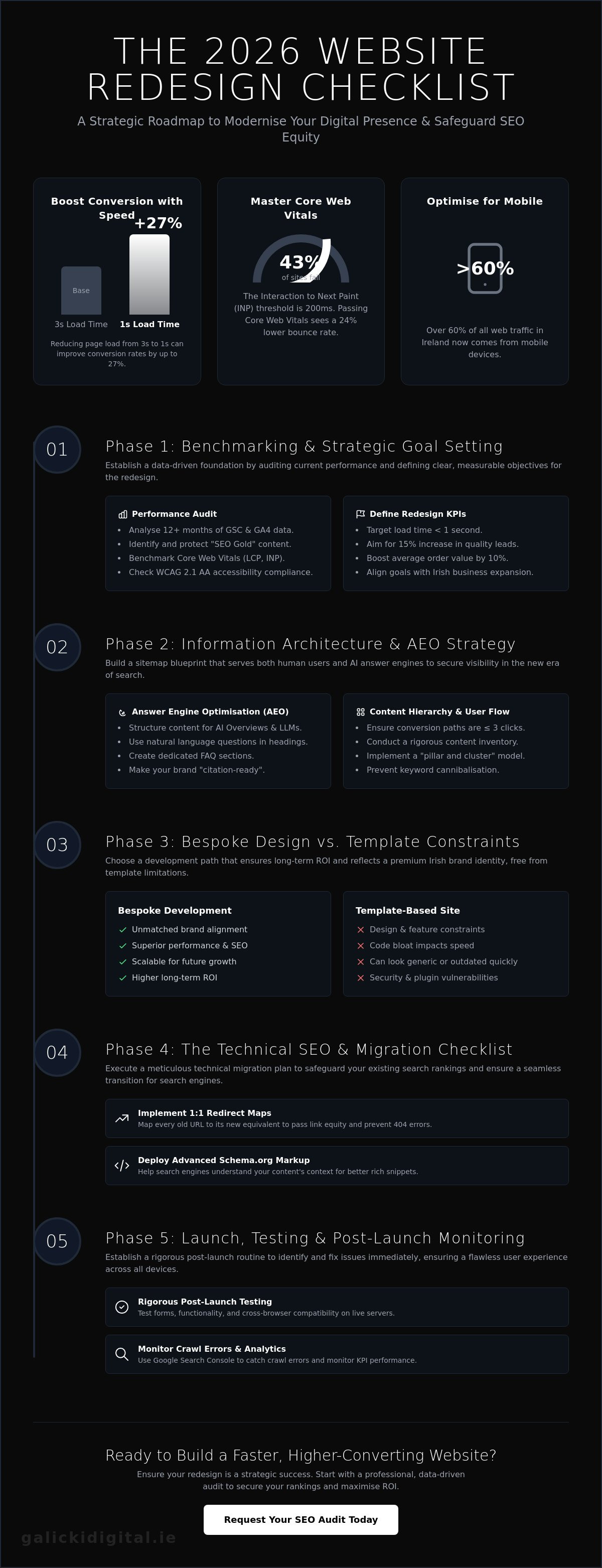
Did you know that reducing your page load time from three seconds to one second can improve your conversion rates by up to 27%? In Ireland, where over 60% of web traffic now comes from mobile devices, a sluggish site is a significant business liability. You likely feel that a major update is a gamble that could tank your existing organic traffic and waste your hard-earned rankings. This website redesign process checklist provides a comprehensive, step-by-step framework to modernise your digital presence whilst preserving every bit of your SEO equity.
We understand the worry of investing between €30,000 and €80,000 in a bespoke redesign only for it to feel obsolete within a year. This guide ensures your brand is ready for the era of AI search engines by mastering the latest Core Web Vitals, including the Interaction to Next Paint (INP) threshold of 200 milliseconds. You’ll learn how to meet the April 24, 2026, accessibility standards and implement a technical migration plan that protects your visibility. We’re providing a clear roadmap to help you build a faster, higher-converting website that’s fully optimised for both human users and AI answer engines.
Key Takeaways
- Learn how to treat your website redesign process checklist as a strategic roadmap that prioritises user behaviour and conversion paths over simple aesthetic changes.
- Discover how to organise your sitemap for Answer Engine Optimisation (AEO) to ensure your brand is cited by AI search bots and LLMs.
- Understand the long-term ROI of bespoke web development compared to template constraints to ensure your site reflects a premium Irish brand identity.
- Master the technical migration process by implementing 1:1 redirect maps and advanced Schema.org markup to safeguard your search rankings during the transition.
- Establish a rigorous post-launch testing and monitoring routine to catch crawl errors and maintain a flawless experience across all devices.
Phase 1: Benchmarking and Strategic Goal Setting
Treating a website redesign process checklist as a mere series of tasks is a mistake that often leads to stagnant ROI. In 2026, this document must serve as a strategic pivot point for your Irish business. Before a single pixel is moved, you need to understand exactly what is working on your current site and what is driving users away. It isn’t just about traffic volume anymore; it’s about identifying your “SEO Gold.” These are the specific landing pages and content clusters that contribute to your bottom line, whether through direct sales or high-value lead generation. Protecting these assets during a transition is the difference between a successful launch and a digital disappearing act.
Your goal is to align your digital presence with modern web design principles that prioritises the user’s intent. This means looking closely at conversion paths. Are users dropping off at the checkout or contact form? Does your current site structure confuse potential clients in Dublin or Cork? By auditing user behaviour now, you can build a site that doesn’t just look better but actually works harder for your business.
The Pre-Redesign Performance Audit
Start by pulling at least twelve months of data from Google Search Console and GA4. You’re looking for the keywords that actually result in conversions, not just vanity metrics. Since sites that pass all three Core Web Vitals thresholds see a 24% lower bounce rate, you must benchmark your current Largest Contentful Paint (LCP) and Interaction to Next Paint (INP) scores. Analyse heatmaps to pinpoint where Irish users get frustrated. With 43% of websites still failing the INP threshold of 200 milliseconds, identifying these friction points early gives you a significant competitive advantage. Finally, check your compliance against WCAG 2.1 AA standards, as the April 24, 2026, deadline has made accessibility a non-negotiable requirement for modern brands.
Defining Your Redesign KPIs
Successful redesigns are built on measurable objectives. Move away from vague desires for “more traffic” and set specific targets for 2026. For example, aim to reduce page load time from three seconds to under one second, which can improve conversion rates by up to 27%. Your KPIs should reflect your broader business expansion plans across Ireland, focusing on lead quality and brand authority. Whether you’re targeting a 15% increase in local service enquiries or a 10% boost in average order value, these metrics will guide every design and development decision in the coming phases. Establishing these benchmarks now ensures your website redesign process checklist remains focused on delivering a high-performing, future-proofed asset.
Phase 2: Information Architecture and AEO Strategy
Once you’ve established your benchmarks, the next stage of your website redesign process checklist involves building a blueprint that serves two masters: the human user and the AI “answer engine.” In 2026, a sitemap isn’t just a list of pages. It’s a semantic map that explains the relationship between your services to LLMs like Google’s AI Overviews or Perplexity. If your information architecture is cluttered, these tools won’t cite you. You need to organise your content so that the path to conversion is never more than three clicks away for a visitor in Dublin or Galway.
Developing a rigorous content inventory is vital. You must decide which assets stay, which are deleted, and which require a total rewrite to meet modern standards. This process prevents keyword cannibalisation and ensures your topical authority remains intact. If you’re unsure where your current content stands, a professional SEO audit can highlight the gaps before you begin the design phase.
Designing for Conversational Search
Traditional keyword stuffing is dead. To win in 2026, you must prioritise Answer Engine Optimisation (AEO). This means incorporating natural language patterns into your H2 and H3 headings. Instead of a heading that just says “Our Services,” use “How can bespoke web design improve my business ROI?” Create dedicated FAQ sections that directly answer the queries you’ve identified in your research. For a deeper dive into this shift, read our guide on what is answer engine optimization. This approach makes your site “citation-ready,” increasing the likelihood of appearing in AI-generated summaries.
Content Mapping and Hierarchy
We recommend a “pillar and cluster” model to demonstrate clear topical authority. Your pillar pages should provide a comprehensive overview of a core topic, whilst your cluster pages dive into specific sub-topics, all linking back to the main hub. This structure helps search bots understand your expertise.
- Audit existing assets: Identify high-performing pages that must be migrated without structural changes.
- Plan for rich media: Decide where video testimonials or interactive calculators will sit to enhance engagement.
- Map user journeys: Ensure every page has a clear, logical next step that leads toward your primary KPI.
By mapping these journeys early, you ensure your new site isn’t just a digital brochure but a high-performance sales tool. This structural clarity is what separates a premium national brand from a generic template.
Phase 3: Bespoke Design vs. Template Constraints
Choosing between a pre-made template and a custom build is a pivotal moment in your website redesign process checklist. Whilst a €60 theme might look attractive on the surface, it often carries a heavy burden of technical debt. Most off-the-shelf templates are designed to cater to everyone, which means they include massive amounts of unused code. This “bloat” is a primary reason why 43% of sites still fail the INP threshold. In contrast, bespoke WordPress development ensures your site only contains the code it actually needs. This lean architecture isn’t just about speed; it’s the foundation for passing Google’s Core Web Vitals and securing a long-term competitive edge in the Irish market.
A custom-built site reflects a premium national brand in a way that a template never can. When you control the architecture, you can ensure that every element is optimised for the user journey you mapped out in Phase 2. This level of precision supports better SEO because search engine crawlers can easily navigate and index your content without getting stuck in a maze of redundant scripts. Investing in a bespoke solution is a move from a disposable digital brochure to a high-performance business asset that scales as you grow.
The Hidden Costs of Website Templates
Relying on a template usually means stacking dozens of third-party plugins to achieve the functionality your business requires. Each plugin is a potential security vulnerability and a weight on your server response time. As your Irish business scales, these templates become rigid cages that prevent you from adding unique features or optimising specific conversion paths. Investing in bespoke web design ireland services allows you to build a scalable asset that grows alongside your revenue, rather than a disposable site that needs replacing every two years. The long-term ROI of custom code far outweighs the initial savings of a cheap theme.
User Experience (UX) and Brand Consistency
A premium brand cannot afford to look like a generic carbon copy. Custom-built sites allow for total control over your typography, colour palette, and interactive elements, ensuring consistency across every digital touchpoint. We move beyond “mobile-responsive” to a “mobile-first” philosophy, acknowledging that over 60% of your visitors are likely on a handheld device. Bespoke design is the strategic alignment of unique code with your unique business goals. It ensures your site isn’t just another entry on the web but a high-performance tool tailored to your specific audience’s behaviour. This approach guarantees that your brand identity remains intact, regardless of the device or platform your customer uses.
Phase 4: The Technical SEO and Migration Checklist
This is the most critical stage of your website redesign process checklist. It’s the point where most businesses inadvertently tank their organic rankings by failing to account for the technical debt of their old site. You must execute a precise 1:1 redirect map to ensure that no user or search bot encounters a 404 error. This isn’t just about keeping the site tidy; it’s about transferring the “SEO Gold” and authority you’ve built over years to your new architecture. Beyond redirects, you need to implement advanced Schema.org markup. This structured data is the language of AEO, allowing AI search engines to parse your service details and cite your brand in AI Overviews.
Before the “go-live” button is pressed, a rigorous technical audit is mandatory. You must verify that your SSL certificate is active and that canonical tags are correctly implemented to prevent content duplication. Check your robots.txt file to ensure it isn’t accidentally blocking search engine crawlers from indexing your new pages. Every image and asset must be optimised for performance, ensuring your visual brand remains sharp whilst keeping file sizes minimal for rapid loading across Ireland’s 5G and broadband networks.
SEO Preservation Tactics
Create a master spreadsheet that maps every single old URL to its most relevant new counterpart. Once the map is ready, update your internal links to point directly to these new URLs. This prevents redirect chains, which frustrate users and dilute the “link juice” search engines pass through your site. Redirecting every old page to your new homepage is a lazy tactic that confuses search engines and destroys the topical relevance of your individual pages, leading to a sharp decline in keyword rankings.
Performance and Core Web Vitals
Use your staging environment to test Largest Contentful Paint (LCP) and Cumulative Layout Shift (CLS) before the public sees the site. You should aim for an LCP under 2.5 seconds to meet Google’s current standards for a good user experience. Ensure all visual assets use modern formats like WebP or AVIF, which offer superior compression compared to legacy JPEGs. Finally, verify that your hosting environment is specifically tuned for high-traffic national campaigns. If you’re concerned about the technical health of your current setup, a professional SEO audit can identify hidden migration risks before they impact your bottom line.
By treating this phase with the technical respect it deserves, you ensure your redesign is a launchpad for growth rather than a recovery project. A flawless migration is what allows your new bespoke design to truly shine in search results.
Phase 5: Launch, Testing, and Post-Launch Monitoring
The final phase of your website redesign process checklist is where the theoretical meets the practical. Many Irish businesses treat the launch as the finish line; however, in 2026, it’s actually the starting pistol for a sustained growth phase. You must perform exhaustive cross-browser and cross-device testing to ensure that your bespoke architecture performs flawlessly on everything from the latest iPhone to older desktop browsers used in offices across Cork and Galway. Since 43% of websites still fail the INP threshold of 200 milliseconds, your post-launch monitoring should focus heavily on real-world user interaction data to ensure your site remains snappy and responsive.
Monitoring Google Search Console for crawl errors or sudden ranking fluctuations is vital in the first 72 hours after go-live. Even with a perfect redirect map, real-world traffic often reveals edge cases that require immediate attention. Integrating AEO tracking into your routine is equally important. You need to see how your site is appearing in conversational search results and whether you’re being cited as a primary source in AI-powered summaries. This feedback loop allows you to refine your content clusters to better serve both human intent and the machine learning algorithms that now dominate the search landscape.
The Final Launch Day Checklist
Before you announce your new site to your customers, run through these essential technical checks to avoid a digital false start.
- Indexation: Verify that the “Discourage search engines from indexing this site” setting in your CMS is unticked.
- Sitemaps: Submit your new XML sitemap to Google and Bing Search Consoles immediately to accelerate the crawling of your new structure.
- Tracking: Check that all GA4 and conversion tracking codes are firing correctly; missing data in the first week can skew your performance analysis for months.
Iterative Growth and AEO Monitoring
A static website is a declining asset. Use your post-launch data to refine your conversion rate optimisation (CRO) strategy, making small adjustments to button placements or form fields based on actual user behaviour. Regularly update your content to maintain freshness, which remains a key ranking signal for 2026 search engines. Galicki Digital acts as your partner for this ongoing bespoke evolution. We don’t just build a site and walk away; we provide the AEO services and technical oversight needed to ensure your digital presence remains a market leader. Establishing a recurring maintenance schedule will keep your site secure, fast, and ready for whatever the next shift in search technology brings. Your redesign is not a one-off project but the foundation of your brand’s future authority.
Future-Proof Your Irish Digital Presence
A successful redesign in 2026 is no longer about a fresh coat of paint; it’s a structural pivot toward AI-readiness and technical excellence. By following this website redesign process checklist, you’ve learned how to protect your hard-earned SEO equity whilst building a site that meets the strict April 2026 accessibility standards. You now understand that bespoke architecture isn’t just a luxury. It’s a strategic necessity to ensure your brand remains visible in AI search results and delivers the sub-1-second load times that modern Irish consumers expect.
Galicki Digital specialises in Bespoke WordPress Development and high-level Technical SEO for national brands across Ireland. We ensure your digital evolution is backed by data-driven AEO services and a flawless migration strategy. Don’t leave your search rankings to chance during a transition. Book your bespoke website redesign consultation with Galicki Digital today to secure your competitive advantage. Your new website should be your most powerful salesperson, and we’re here to help you build it.
Frequently Asked Questions
How long does a professional website redesign typically take?
A professional redesign for a mid-sized Irish company typically takes between 12 and 24 weeks from the initial audit to the final launch. This timeline allows for deep strategic benchmarking, bespoke design iterations, and the technical migration phase. More complex enterprise projects with custom integrations or large-scale content inventories can extend beyond six months to ensure every performance metric is met.
Will a website redesign hurt my current SEO rankings?
A redesign only hurts your rankings if the migration is handled poorly without a 1:1 redirect map. When you follow a technical website redesign process checklist, you actually protect your authority whilst improving your site’s health. Sites that pass all three Core Web Vitals thresholds see a 24% lower bounce rate on average, which often leads to improved search visibility and higher conversion rates over time.
What is the difference between a redesign and a re-platform?
A redesign focuses on the visual interface, user experience, and information architecture, whilst a re-platform involves moving your site to a different Content Management System (CMS). You can redesign your site on your current platform or choose to move to a more flexible system like a bespoke WordPress build. Re-platforming is often necessary if your current CMS lacks the speed or accessibility features required for 2026 standards.
How much does a bespoke website redesign cost in Ireland?
In 2026, a mid-range business redesign in Ireland with custom UI and CMS improvements typically costs between €30,000 and €80,000. Smaller projects for local businesses with 5 to 10 pages range from €2,000 to €10,000. High-end enterprise redesigns involving custom architecture and advanced integrations can exceed €100,000 or even €200,000 depending on the project’s complexity and technical requirements.
Do I need to rewrite all my content during a redesign?
You don’t need to rewrite every word, but you must audit your existing content to ensure it meets modern Answer Engine Optimisation (AEO) standards. Many pages will benefit from being restructured into natural language patterns to better serve conversational search queries. This process ensures your brand is “citation-ready” for AI search engines whilst removing outdated or duplicate content that might be diluting your topical authority.
What is the most important part of a website redesign process checklist?
The technical SEO migration and redirect mapping is the most critical component of a website redesign process checklist. Failing to map old URLs to new counterparts is the primary reason businesses lose traffic during a launch. This step ensures that search engine crawlers can find your new pages easily and that any existing backlinks continue to pass authority to your new site structure.
Can I keep my current hosting provider during a redesign?
You can keep your current provider if their server response times allow you to meet the 200ms Interaction to Next Paint (INP) threshold. However, since 43% of websites still fail this metric, you should verify that your hosting environment is optimised for high-traffic national campaigns. If your current host cannot support sub-1-second load times, the redesign phase is the perfect time to migrate to a more robust, performance-oriented environment.
How often should a business redesign its website?
Most Irish businesses should consider a full redesign every three to five years to stay competitive and technically compliant. Technology moves quickly; for instance, the April 24, 2026, deadline for WCAG 2.1 AA compliance has made many older sites legally and functionally obsolete. Regular updates ensure your site remains compatible with the latest browser behaviours and search engine algorithms, preventing your digital presence from becoming a business liability.